Biology of Water Hyacinth (Eichhornia crassipes)
Key Takeaways
- Water hyacinth (Eichhornia crassipes) is a free-floating monocot with highly specialized morphological adaptations for aquatic life.
- Inflated petioles containing aerenchyma tissue provide buoyancy and enable gas transport to submerged roots.
- The extensive adventitious root system facilitates rapid nutrient uptake from the water column.
- Tristylous flowers promote genetic diversity through outcrossing, though vegetative reproduction dominates population growth.
- The C3 photosynthetic pathway supports exceptionally high net primary productivity rates among vascular plants.
- Morphological plasticity allows the species to adjust growth form in response to population density and environmental conditions.
Introduction
Eichhornia crassipes (Mart.) Solms is a perennial, free-floating aquatic macrophyte of the family Pontederiaceae 1. The species has attracted extensive scientific attention due to its status as one of the most ecologically and economically damaging invasive aquatic plants worldwide 2. Understanding the biology of water hyacinth is essential for developing effective management strategies and predicting its behavior across diverse freshwater environments. For a general overview of the species, see What Is Water Hyacinth?.
Vegetative Morphology
Root System
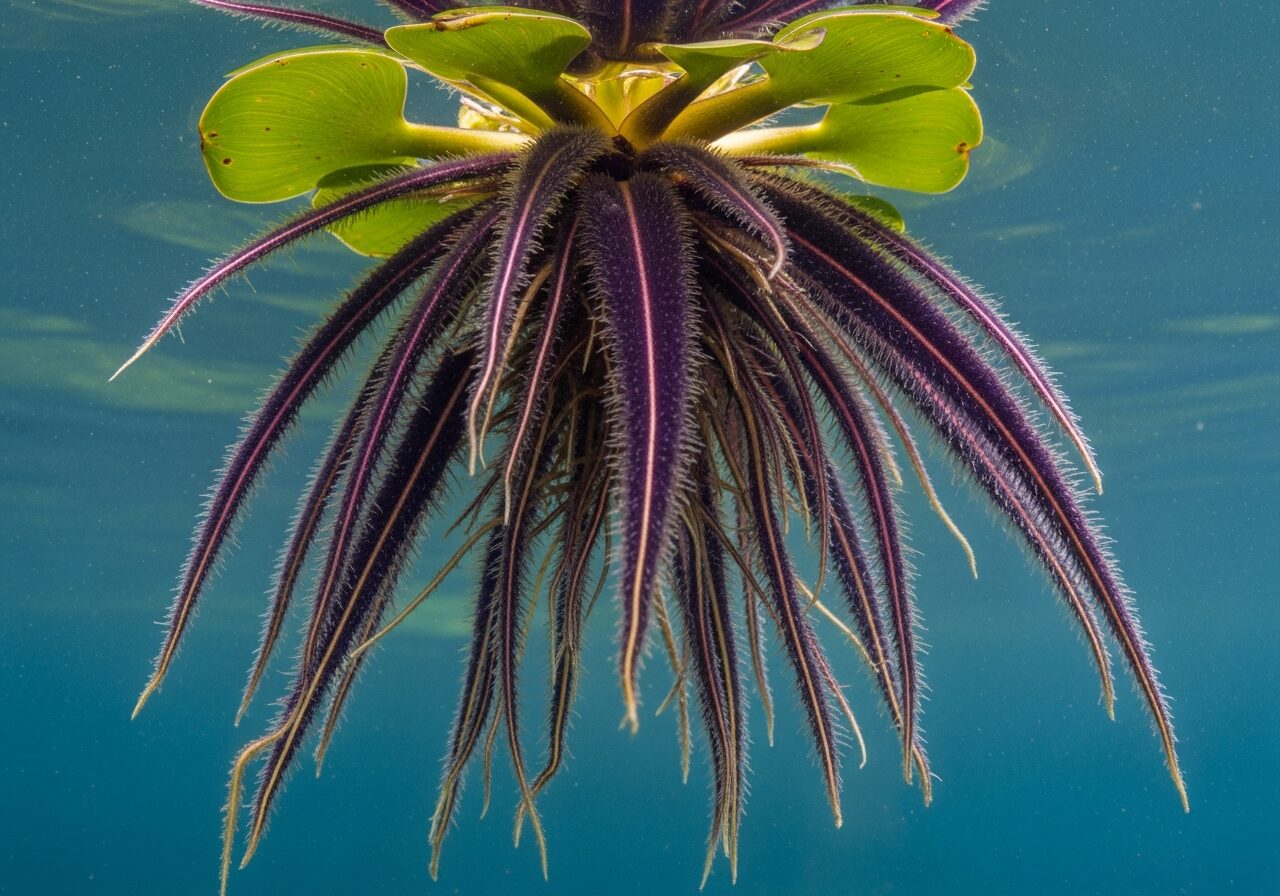
The root system of E. crassipes is entirely adventitious, arising from the base of the rosette at the junction of the stem and petioles. Roots are fibrous, densely branched, and typically dark purple to black in coloration due to the presence of anthocyanin pigments. In deep-water or nutrient-poor environments, roots may extend up to 300 centimeters below the water surface, maximizing the absorptive area available for nutrient uptake.
Root hairs are abundant along the length of each rootlet, significantly increasing the total surface area of the root system. This morphological feature enhances the plant's capacity for the absorption of dissolved nitrogen, phosphorus, and micronutrients from the water column. The root system also functions as a physical anchor within floating mats, contributing to the structural integrity of dense aggregations.
Petioles and Aerenchyma
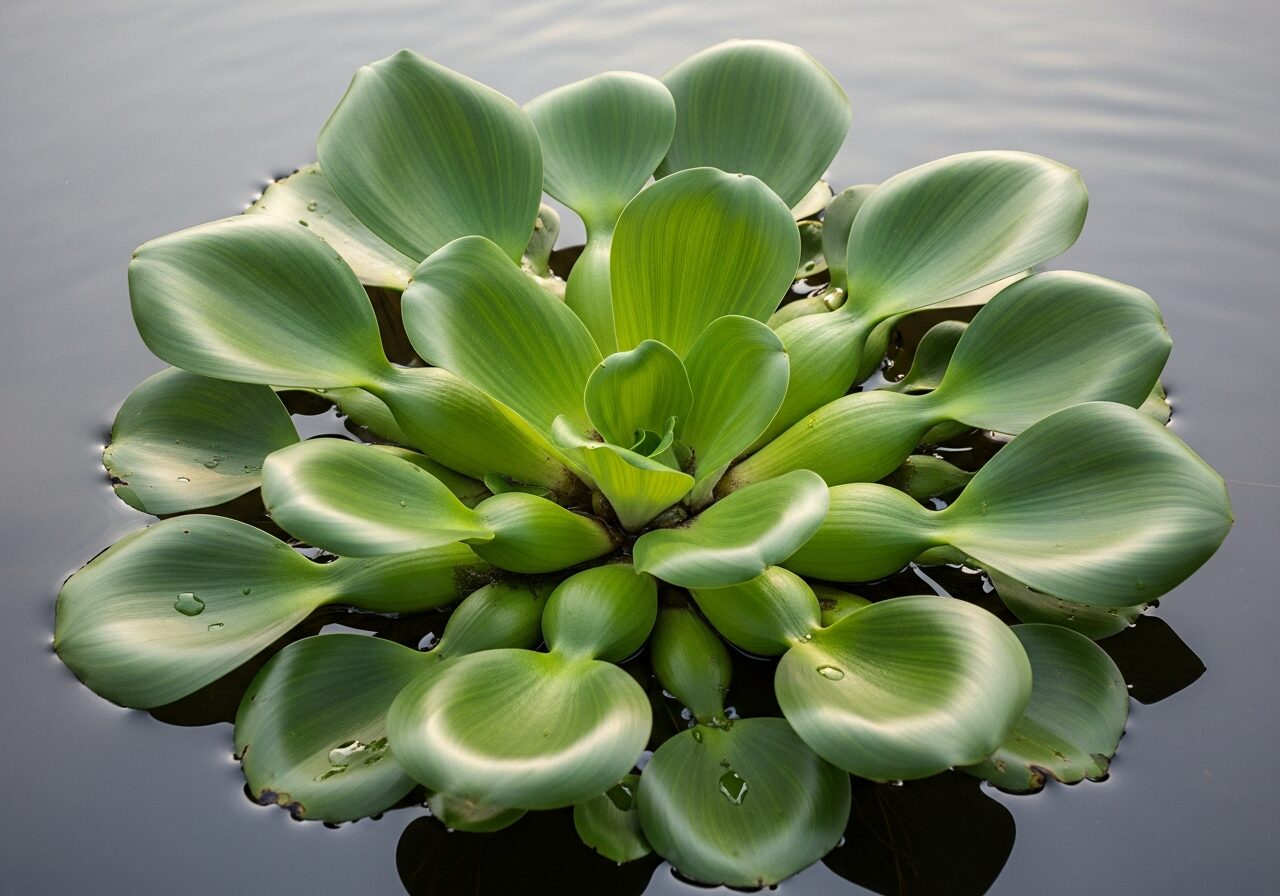
The petioles of E. crassipes exhibit remarkable morphological plasticity in response to growth conditions. In uncrowded populations with ample light and space, petioles develop a characteristic bulbous, swollen form. These inflated structures contain extensive aerenchyma tissue — large, gas-filled intercellular spaces that may constitute up to 70 percent of the petiole volume. The aerenchyma serves dual functions: providing buoyancy to maintain the photosynthetic canopy above the waterline, and facilitating the internal diffusion of oxygen from aerial tissues to submerged roots.
Under crowded conditions, where competition for light intensifies, petioles elongate and become cylindrical, losing the characteristic bulbous morphology. This plastic response allows individual plants to position their leaves above competitors in dense stands, though at the cost of reduced buoyancy per unit of tissue.
Leaf Architecture
Leaves are arranged in a basal rosette and consist of a petiole and a broadly ovate to circular lamina. Leaf blades measure 5 to 15 centimeters in diameter, with entire margins and a glossy, waxy adaxial surface that repels water and reduces surface wetting. The laminae are thick and coriaceous, with prominent parallel venation typical of monocotyledons. The waxy cuticle minimizes transpirational water loss and provides protection against ultraviolet radiation.
The leaf area index of mature water hyacinth stands is exceptionally high, often exceeding values observed in terrestrial crop canopies. This dense canopy architecture maximizes light interception and contributes to the species' competitive dominance over co-occurring aquatic macrophytes.
Stolons and Vegetative Architecture
Horizontal stolons extend laterally from the mother plant, producing daughter rosettes (ramets) at their tips. Stolons are typically 10 to 30 centimeters in length and may produce multiple ramets in rapid succession under favorable conditions. The stoloniferous growth habit enables rapid lateral expansion of floating mats and is the primary mechanism of population increase in established colonies.
The interconnected network of mother plants, stolons, and daughter ramets creates structurally cohesive floating mats that can withstand considerable wave action and wind disturbance. This colonial architecture is a key feature enabling the species to dominate large areas of water surface.
Floral Biology
Inflorescence Structure
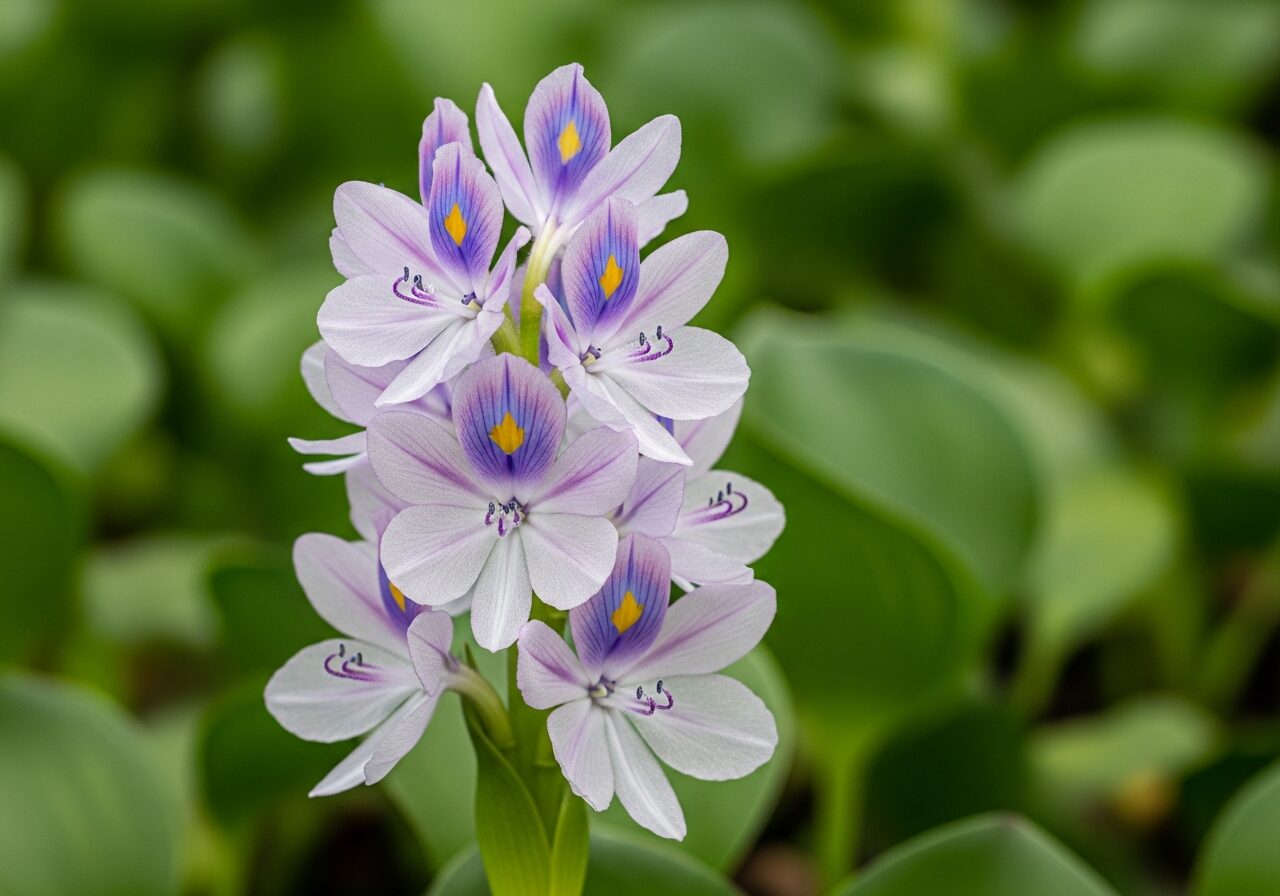
The inflorescence of E. crassipes is a terminal spike borne on an erect peduncle that emerges from the center of the leaf rosette. Each spike bears 8 to 15 individual flowers arranged in a spiral pattern. Individual flowers are approximately 4 to 7 centimeters in diameter, with a bilaterally symmetrical perianth composed of six tepals fused at the base into a short tube.
The most prominent visual feature of the flower is the uppermost tepal, which bears a conspicuous yellow spot surrounded by a blue-violet border. This marking functions as a nectar guide, directing pollinating insects toward the reproductive structures at the center of the flower.
Tristyly
Eichhornia crassipes exhibits tristyly, a relatively uncommon floral polymorphism in which three distinct style morphs — long-styled, mid-styled, and short-styled — coexist within populations. Each morph has stamens positioned at the two levels not occupied by the style, promoting cross-pollination between morphs by insect visitors. This system maintains genetic diversity within sexually reproducing populations and reduces the incidence of self-fertilization.
In many invasive populations outside the native range, only one or two style morphs are present, reflecting founder effects during introduction events 3. The reduced morph diversity may limit sexual reproduction efficiency but has not prevented the species from achieving invasive dominance, as vegetative reproduction is the primary mode of population increase.
Physiological Adaptations
Photosynthesis and Productivity
Eichhornia crassipes utilizes the C3 photosynthetic pathway and achieves net primary productivity rates of 60 to 110 metric tons of dry biomass per hectare per year under optimal conditions 4. These productivity rates are among the highest recorded for any vascular plant species and rival those of intensively managed agricultural crops such as sugarcane and maize.
The high photosynthetic output is supported by several factors: a large and rapidly regenerating leaf canopy, efficient light interception, rapid nutrient cycling within the plant body, and the absence of structural investment in woody support tissues. The species maintains positive net carbon assimilation across a broad range of light intensities, though maximum photosynthetic rates are achieved under full sunlight conditions.
Nutrient Uptake and Bioaccumulation
The capacity of E. crassipes for nutrient absorption is exceptional. Experimental studies have documented nitrogen uptake rates of 2.4 to 4.8 milligrams per gram of dry weight per day and phosphorus uptake rates of 0.4 to 1.2 milligrams per gram of dry weight per day. The species thrives in eutrophic conditions and responds to elevated nutrient availability with accelerated growth, increased biomass production, and enhanced vegetative reproduction.
Beyond macronutrient uptake, water hyacinth has demonstrated a significant capacity for the bioaccumulation of heavy metals, including cadmium, chromium, copper, lead, mercury, nickel, and zinc 5. This phytoremediation potential has generated interest in the use of the species for wastewater treatment applications, though the management and disposal of contaminated biomass remain practical challenges.
Thermal and Salinity Tolerance
Water hyacinth is primarily a tropical and subtropical species, with optimal growth occurring at temperatures between 25 and 30 degrees Celsius. The species is sensitive to frost, and sustained temperatures below 10 degrees Celsius result in tissue damage and mortality. This thermal sensitivity limits the species' poleward distribution and provides a natural check on its expansion into temperate regions.
Salinity tolerance is limited, with significant growth reduction observed at concentrations above 2 parts per thousand. This restriction confines the species to freshwater environments, though transient populations may persist in brackish estuarine zones during periods of low salinity.
Ecological Significance of Morphological Traits
The morphological and physiological traits of E. crassipes collectively constitute a suite of adaptations that enable rapid colonization, competitive dominance, and ecological transformation of invaded freshwater systems. The combination of high reproductive output, efficient nutrient acquisition, structural flexibility, and tolerance of a wide range of environmental conditions makes water hyacinth one of the most successful aquatic invaders in the world. For further discussion of the ecological consequences of these adaptations, see Ecological Impact.
Frequently Asked Questions
What makes water hyacinth float?
Water hyacinth floats due to aerenchyma tissue in its swollen petioles. These gas-filled intercellular spaces can constitute up to 70 percent of the petiole volume, providing natural buoyancy that keeps the plant and its leaves above the waterline without any attachment to the substrate.
How large can a water hyacinth plant grow?
Individual plants typically reach 30 to 100 centimeters above the water surface, though specimens exceeding 150 centimeters have been recorded in nutrient-rich environments. Root systems can extend up to 300 centimeters below the surface in deep-water conditions.
What type of photosynthesis does water hyacinth use?
Water hyacinth uses the C3 photosynthetic pathway. Despite this, it achieves exceptionally high productivity rates of 60 to 110 metric tons of dry biomass per hectare per year, making it one of the most productive vascular plants known.
Why are water hyacinth roots purple?
The dark purple to black coloration of water hyacinth roots is caused by anthocyanin pigments. These pigments may provide some protection against ultraviolet radiation in shallow, clear-water environments and are a distinguishing morphological characteristic of the species.
Can water hyacinth tolerate saltwater?
Water hyacinth is predominantly a freshwater species and does not tolerate significant salinity. Growth is substantially reduced at concentrations above 2 parts per thousand, which confines the species to freshwater lakes, rivers, and wetlands rather than marine or brackish environments.
Explore Related Topics
Understanding the biology of water hyacinth provides the foundation for appreciating its ecological consequences and the strategies used to manage it. Explore these related articles for a broader perspective.
- What Is Water Hyacinth? — A general introduction to the species and its significance
- Ecological Impact of Water Hyacinth — How water hyacinth transforms freshwater ecosystems
- Reproduction and Spread of Water Hyacinth — How the biological traits discussed here drive explosive population growth
- Biological Control of Water Hyacinth — Natural enemies that exploit the plant's biology for population suppression
- Global Distribution of Water Hyacinth — Where these biological adaptations have enabled successful invasion worldwide
References
- Gopal, B. (1987). Water Hyacinth. Elsevier Science Publishers.
- Villamagna, A. M., & Murphy, B. R. (2010). Ecological and socio-economic impacts of invasive water hyacinth (Eichhornia crassipes): A review. Freshwater Biology, 55(2), 282–298.
- Barrett, S. C. H. (1980). Sexual reproduction in Eichhornia crassipes. Biotropica, 12(4), 298–306.
- Reddy, K. R., & DeBusk, W. F. (1984). Growth characteristics of aquatic macrophytes cultured in nutrient-enriched water. Economic Botany, 38(2), 229–239.
- Center, T. D., Dray, F. A., Jubinsky, G. P., & Grodowitz, M. J. (2002). Biological control of water hyacinth under conditions of maintenance management. Biological Control, 23(1), 109–123.
Related Research
Vegetative fragmentation, stolons, seed biology, growth rates, and dispersal pathways of Eichhornia crassipes.
Weevils and other biocontrol agents, mechanisms, success factors, limitations.
Aquatic herbicide concepts, timing, selectivity, safety, and integrated planning.